







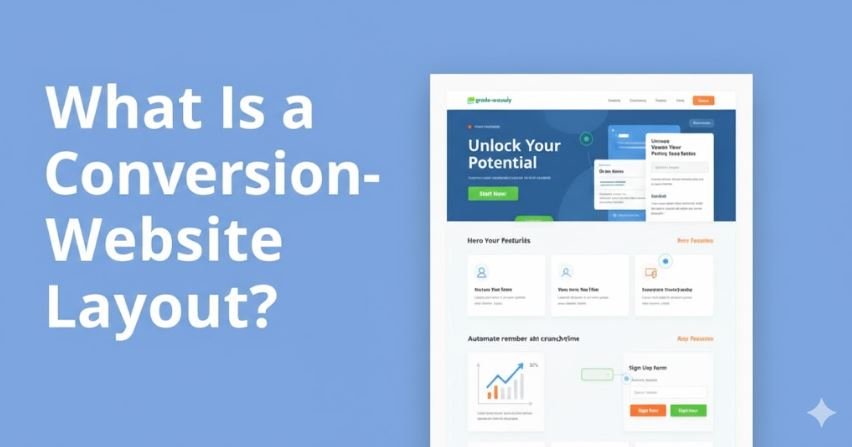
The conversion-focused design of the website assists visitors to perform particular and valuable actions which are considered as the contribution towards the business targets like sales, inquiries, and sign-ups. Professional Website Design Services focus on aligning user behavior with these goals by guiding visitors through a clear and purposeful journey.
The design of the website reduces the demand for making choices by the customer, making the process easier and more intuitive for them. Each and every element on the page has a specific purpose and contributes directly to the primary objective.
For UK businesses, this design layout is trust-inspiring and search engine friendly. It ensures that the visitors feel comfortable while using the website.
What Conversion-Focused Means
Conversion-oriented design is all about online behavior. The conversion-oriented design is based on the users’ wants, needs, and expectations during their visit to the website. Hence, the website design channels the users to a particular action, which could be that of buying, asking for more information, or subscribing to the newsletter.
In addition, a design strategy would eliminate the distractions and limit the attention solely to the most essential elements. It utilizes data, research, and design principles to uplift the overall website performance.
Why Conversions Are Important
Visitors to most websites have very little time and attention to spare. Users will always be on the lookout for quick solutions and indications while browsing. They will not hesitate to walk away from a website that appears to be confusing without performing any action if the website is not straightforward.
For online shoppers in the UK, the choice is between integrity or obfuscation. A consumer is more likely to be tempted by a “sale” if the business is upfront about its business.
Clear Layout Structure
An organized layout that allows the most significant information to be presented at the top and shared in a simple manner. It should be the most critical and eye-catching information, and then in an orderly and readable way, all other supporting information should be presented. Thus, the audience is enabled to comprehend the information with little to no effort.
Whitespace is used to separate content. It helps to make pages look calm, organized, and scannable.
Strong Value Proposition
A value proposition is the reason why a business is worth choosing. The main message should be in a short, clear, and benefit-oriented manner. No jargon should be used and only the simplest of words should be employed to describe how the business helps customers.
UK users respond well to honest and realistic statements. Clear value builds trust and keeps visitors engaged longer.
Clear Calls to Action
The most essential action for the user is clearly laid-out by a call to action that tells the user what is required of them next. It may be “Get a Quote,” “Contact Us,” or “Buy Now.” These should be prominent and use simple language that matches the purpose of the page.
Calls to action should appear at key points on the page. They should feel helpful, not pushy or confusing.
Simple and Focused Navigation
Navigation helps users move around the website easily. Too many menu items can confuse visitors and slow decisions. A conversion-focused layout keeps navigation short and focused. The main menu should include only the most essential pages.
This allows the user to find whatever they are looking for without being overpowered and at the same time their attention is drawn to the content that facilitates conversion.
Easy-to-Read Content
It is vital that the content is presented in a way that it can be read and understood without difficulty. Having short paragraphs enables the user to skim through the pages without losing focus. Clear headings guide readers through the page smoothly. Simple words improve understanding for all users.
This approach also supports accessibility and mobile browsing. UK users often browse on different devices throughout the day.
Trust Signals That Reassure Users
Trust indicators make users feel secure and confident when using the internet. Examples of trust indicators include reviews and testimonials, as well as UK certifications. They show that real people trust the business already. Trust signals work best near forms or calls to action.
They eliminate doubts and allow users to make decisions faster, which is particularly important for first-time visitors.
Mobile-Friendly Design
Every day, the majority of the population in the UK uses mobile phones to access the internet via the browser. A mobile-friendly design is a must for a conversion-oriented layout. Very small buttons will not do, and text should be legible. On mobile, forms should be short and quick to complete.
The website’s responsive design guarantees that it is usable on all devices. This is a significant aspect that not only raises the user experience but also the rate of conversions.
Forms That Are Easy to Complete
Forms are often the final step before a conversion happens. Long or complex forms can cause users to give up quickly. A good layout keeps forms short and clear. Only necessary information should be requested at first.
Clear labels and helpful messages reduce user frustration. Privacy reassurance also helps UK users feel more comfortable.
Testing and Improving Layouts
A conversion-focused layout should improve over time. User behaviour data shows what works and what does not. Analytics tools measure clicks, scrolls, and form submissions. Layout testing may uncover more effective options.
Small changes result in significant improvements. Testing helps in steady growth and improvement in results.
Common Layout Mistakes
Some sites tend to give priority to aesthetic value rather than usability. An abundance of choices might be a reason for visitors being undecided and hence the process delayed. Main points might be obscured by the use of large images or even animations. Mobile visitors are also being ignored.
These errors decrease clarity and undermine performance. They can be eliminated through planning and design with the user in min
Keeping Layouts Effective Over Time
User expectations change due to technological advancements and habits, which is why working with a professional website redesign agency can be valuable. Periodic assessments and updates for websites are necessary to stay aligned with these changes. Having specific goals helps the team focus on the most important aspects during updates, while proper documentation ensures consistency across the board.
Good layouts are created through learning and improvement. They view design as a continuous process, not a one-time activity.
Conclusion
A conversion-focused website layout supports clear business goals. It guides users smoothly towards helpful and meaningful actions. This approach improves trust, clarity, and performance for UK businesses. By focusing on simplicity and testing, websites achieve better results.
Was this article informational for you? Don’t forget to read our other informational blogs.